An after school routine is the hardest one in the house to hold, because it
runs at the worst possible time. Everybody involved is depleted, nobody has
eaten properly since eleven, and the first twenty minutes set the tone for the
next four hours. Most plans fail there rather than at homework.
What follows is an order, not a timetable. The times will not match your
house. The sequence will.
 Save
SaveWhy the after school routine falls apart
Almost every collapsed afternoon has the same shape. The child comes in,
drops the bag wherever, and goes straight to a screen or a sibling. Forty
minutes later somebody remembers homework, and now you are asking a tired,
under-fed child to do the hardest task of the day with no runway.
The fight that follows is not really about homework. It is about being asked
to switch from decompression back into concentration with no transition in
between — and children are considerably worse at that than adults, who are also
not good at it.
So the routine below front-loads the two things that make concentration
possible, and puts the difficult work in the middle rather than at either end.
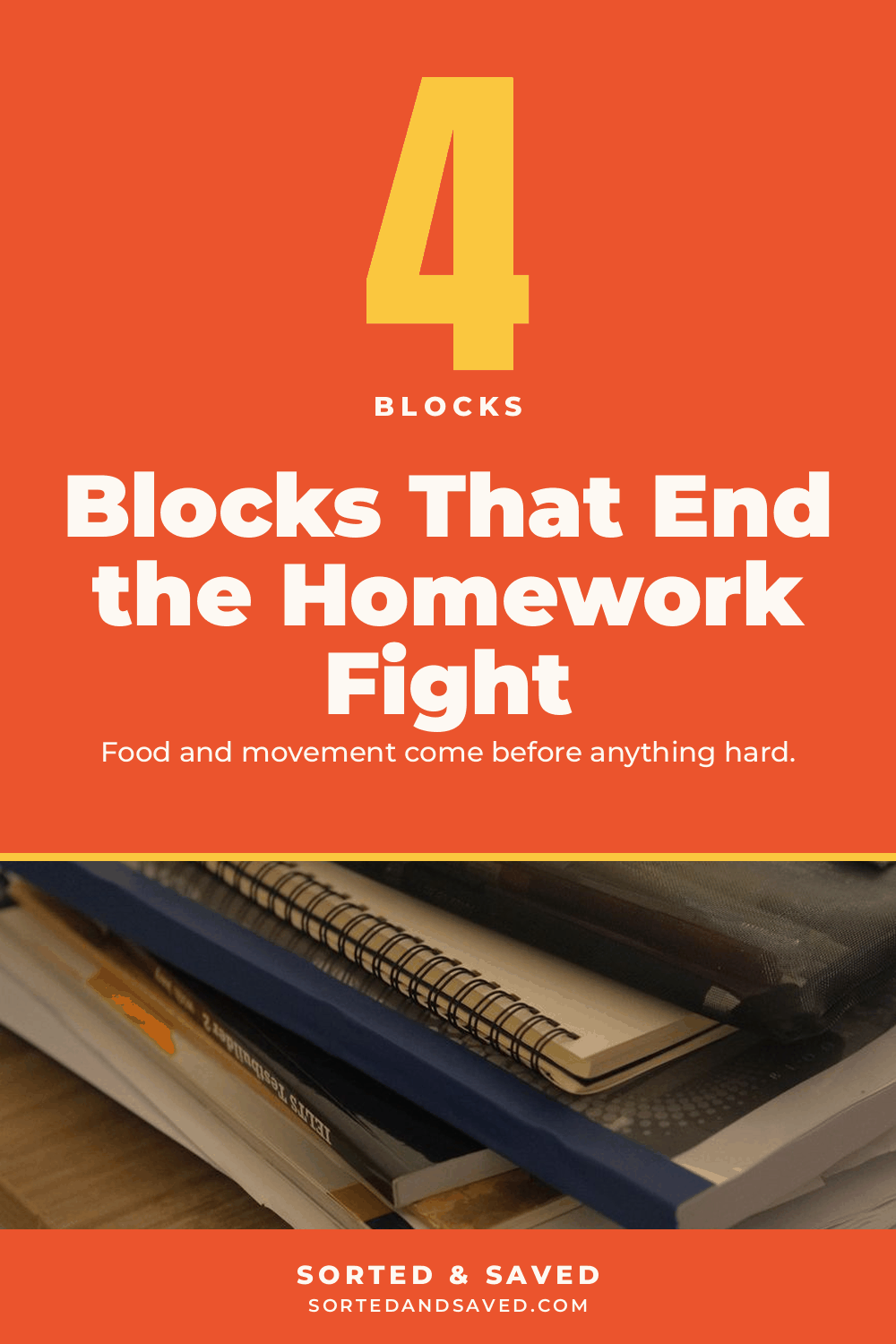
The four blocks
-
Unpack — two minutes, at the door
Bag on its hook. Lunch box emptied into the sink. Any paper that came home
goes into one place — a tray, a clip, a basket on the counter. Not a pile, not a
drawer, and not “I’ll show you later.”This is two minutes and it prevents roughly half of the evening’s problems:
the permission slip found at 7am, the reading book left in the bag, the lunch
box discovered on Sunday. If you have a
family command center, this is what it is for. -
Feed them — properly, not a biscuit
Something with protein and something with substance. A sandwich half, cheese
and crackers, yoghurt, eggs, leftovers. Children eat lunch at 11:30 and are
genuinely hungry by 3, and hunger reads as defiance to almost every adult in
the building.Keep a short list of five things you can produce in three minutes without
thinking. The decision is what makes this block expensive, not the food. The
same principle that makes lunch packing survivable applies
here. -
Move — twenty minutes, outside if possible
Garden, park, bike, trampoline, walking the dog, kicking a ball at a wall. It
does not need to be organised and it should not be a screen. Twenty minutes is
the number where most families see the difference; ten is better than nothing.This is the block people cut first when the afternoon runs late, and it is
the one that makes the next block possible. Cut homework short instead. -
Homework — one table, one timer, everybody at once
Same place every day, cleared of everything else. A timer set to something
age-appropriate. Younger children sit with older ones and do reading or drawing
so nobody is alone with the hard thing.When the timer goes, homework stops, whatever state it is in. If it is
regularly not finished in a reasonable window, that is information for the
teacher rather than a discipline problem at your kitchen table.
 Save
SaveThe fifth block nobody plans for
Ten minutes, after dinner, setting up tomorrow. Bags packed and by the door.
Clothes out. Anything that needs signing, signed. Water bottles filled.
This is the whole point of the afternoon routine, and it is the part that
gets skipped. An afternoon that runs beautifully and ends with nothing prepared
still produces a terrible morning — which is why this pairs directly with
the school morning routine and belongs inside your
evening reset rather than sitting on its own.
What works
- Food before anything difficult
- Movement before homework, not after
- One table, one timer, everyone together
- Papers into one tray at the door
- Tomorrow set up before screens
- Same order every single day
What to watch
- Homework straight through the door
- Snack instead of a real refuel
- Movement only if there's time left
- Homework in bedrooms, separately
- Papers stay in the bag until morning
- A different plan every afternoon
Making it survive a real week
Three adjustments do most of the work.
Name the blocks and post them. Written on the fridge in the
child’s own handwriting, in four lines. Children argue with instructions and
comply with lists, which is the same reason
chore charts outperform verbal reminders.
Accept that activity days are different. On a night with
swimming or football, homework moves to the morning or does not happen. Trying
to run the full routine on a day that has no room for it is how the whole thing
gets abandoned.
Cook something that does not need you. The afternoon routine
and dinner are competing for the same adult. Slow cooker, tray bake, or one of
the thirty-minute school night dinners — anything that
does not require standing at a hob during the homework block.
 Save
SaveThe sleep piece
If afternoons are consistently terrible, look at bedtime before redesigning
the routine again. School-age children need between nine and twelve hours, and
almost none of them are getting it — the
Sleep
Foundation’s guidance on children and sleep sets out the ranges by age.
An overtired child will fail any afternoon system you build. That is worth
ruling out before concluding the routine is wrong.
Common questions
is what makes them survive early finishes, late buses and activity days. If you
need a rough shape, most families run unpack and food inside the first fifteen
minutes and start homework around an hour after the door.
refusal continues with those in place, it is usually about difficulty rather
than willingness, and the useful next step is a conversation with the teacher
about the workload rather than a firmer rule at home.
homework, younger ones read, draw or do a puzzle. The point is that the house
is in work mode together for a defined period, which is far easier to hold than
three separate negotiations.
are extremely difficult to end, because you are asking a child to leave
something engaging for something hard. Afterwards, the same screen becomes the
thing that makes the routine worth finishing.
Start with the door
Do not implement all four blocks tomorrow. Do the two-minute unpack, every
day, for a week, until it happens without being asked.
That one change removes more evening friction than the rest combined, and it
makes the other blocks feel like additions rather than a new regime. The
weekly reset is where you check whether it is still
working.