

Christmas is not actually a lot of work. It’s a moderate amount of work
compressed into three weeks, on top of a normal month, usually by one person.
A christmas planning timeline fixes the compression rather than the workload.
Everything below is ordered by one criterion: does it have a real
deadline, or does it just feel urgent? Things with deadlines go early.
Things that merely feel urgent go last, or get dropped.
 Save
SaveThe christmas planning timeline starts in October
Nothing in October is fun. It’s all administrative, and doing it now is what
buys you a calm December.
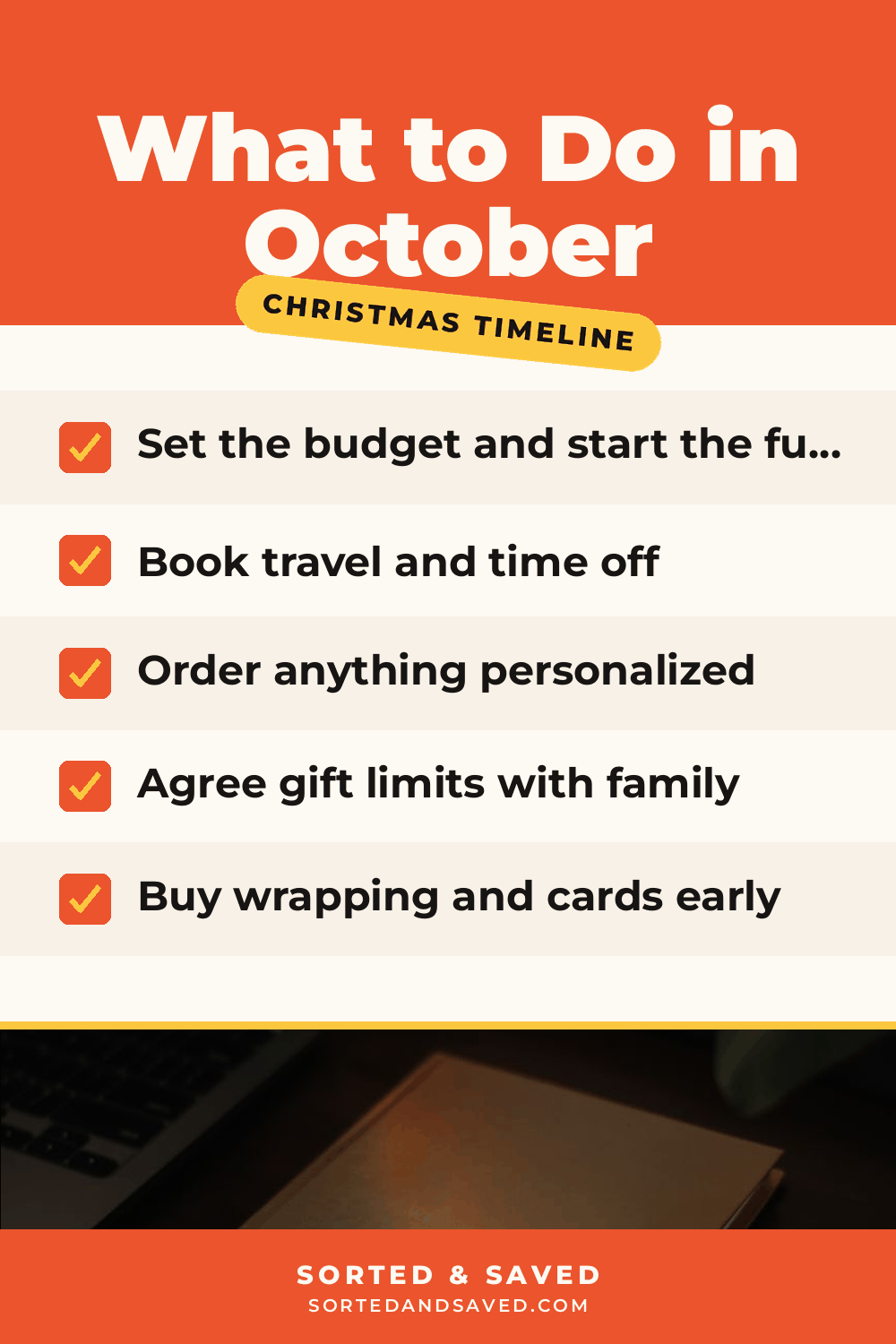
Set the budget. Before any list, before any shopping. This is
the decision every other decision depends on, and
building it backward from what you can spare takes about
twenty minutes.
Book travel and time off. Christmas travel prices only go one
direction, and time off gets claimed. Both are pure loss if you delay.
Order anything personalized or made-to-order. Photo books,
engraving, custom anything. These have production lead times that quietly become
impossible around late November.
Agree limits with family. The conversation nobody wants, which
is dramatically easier in October than in December. Suggest a number, propose
drawing names, or say you’re doing something smaller this year.
Buy wrapping, cards and batteries. None of it is
time-sensitive and all of it is marked up when you’re desperate.
November: the actual work, at normal prices
-
Buy the gifts — first two weeks
Working from the budget and the agreed limits, not from browsing. A list built
in October means November shopping is retrieval rather than discovery, which is
both faster and considerably cheaper.Finishing before the last week of November also means you skip the worst of
the shipping-deadline anxiety entirely. -
Plan the food, don’t buy it — mid month
Decide the menu, count the people, write the list. Order anything that needs
ordering.Buy only non-perishables now. Fresh food bought in November is either frozen
or wasted, and the storage cost isn’t worth the marginal saving. -
Wrap as you go — throughout
Wrap each gift the day it arrives rather than facing a mountain on the 22nd.
It takes the same total time and removes an entire evening of dread.This works because you already bought the wrapping in October. That’s the
whole point of the sequencing. -
Do the house jobs — late November
If people are coming, this is when to do the things you’d otherwise do in a
panic on the 23rd: the spare room, the good towels, whatever’s been broken since
August.Most of this overlaps with the fall reset, so if you did
that in September you’re already most of the way there.
 Save
SaveDecember: hosting, not scrambling
If October and November went as above, December contains three things: fresh
food shopping in the final week, the actual hosting, and time with people.
The one December job worth protecting is the fresh shop. Go early in the final
week rather than on the 23rd — same food, a fraction of the stress, and better
availability.
Keep the weekly reset running through December rather than abandoning it. It’s
the month when the house takes the most use, and a fifteen-minute
Sunday reset is what stops the whole thing feeling chaotic by
the 28th.
What to drop
What works
- Booking travel early
- Ordering personalized gifts in October
- Wrapping as gifts arrive
- Agreeing limits with family
- One fresh shop, done early
What to watch
- Handmade cards for forty people
- A different outfit for every event
- Elaborate advent activities daily
- Baking for people who won't notice
- Matching wrapping paper
- Attending every single invitation
The daily advent activity is the clearest example. It’s a lovely idea that
becomes twenty-four separate obligations landing in the busiest month of the
year. Do six good ones on specific days instead, and nobody will notice the
difference except you.
 Save
SaveCommon questions
production lead time, October is close to the last sensible moment. The timeline
separates those deliberately — nothing festive is asked of you in October.
sooner than you think you need to. First-time hosting reliably takes longer than
expected, and the cost of being early is nothing.
book the train by Friday” gets done; “can you help with Christmas” doesn’t. The
timeline makes this easy because the jobs are already discrete.
else. Drop everything on the skip list without guilt, and start the timeline in
October next year — the difference is genuinely dramatic.
Put three dates in the calendar
First Sunday of October, November and December. Twenty minutes each.
That’s the whole system. The work doesn’t shrink, but it stops arriving all at
once — and that’s what actually makes December feel different.



1 comment