
The expensive money mistakes are not dramatic. Nobody is broke because of one
reckless purchase — they are broke because of six or seven habits that all feel
completely sensible and quietly take the difference every single month.
Eight of them below. Each one has a fix that takes minutes rather than
discipline, which matters, because discipline is the thing that runs out.
 Save
SaveThe money mistakes that cost the most
-
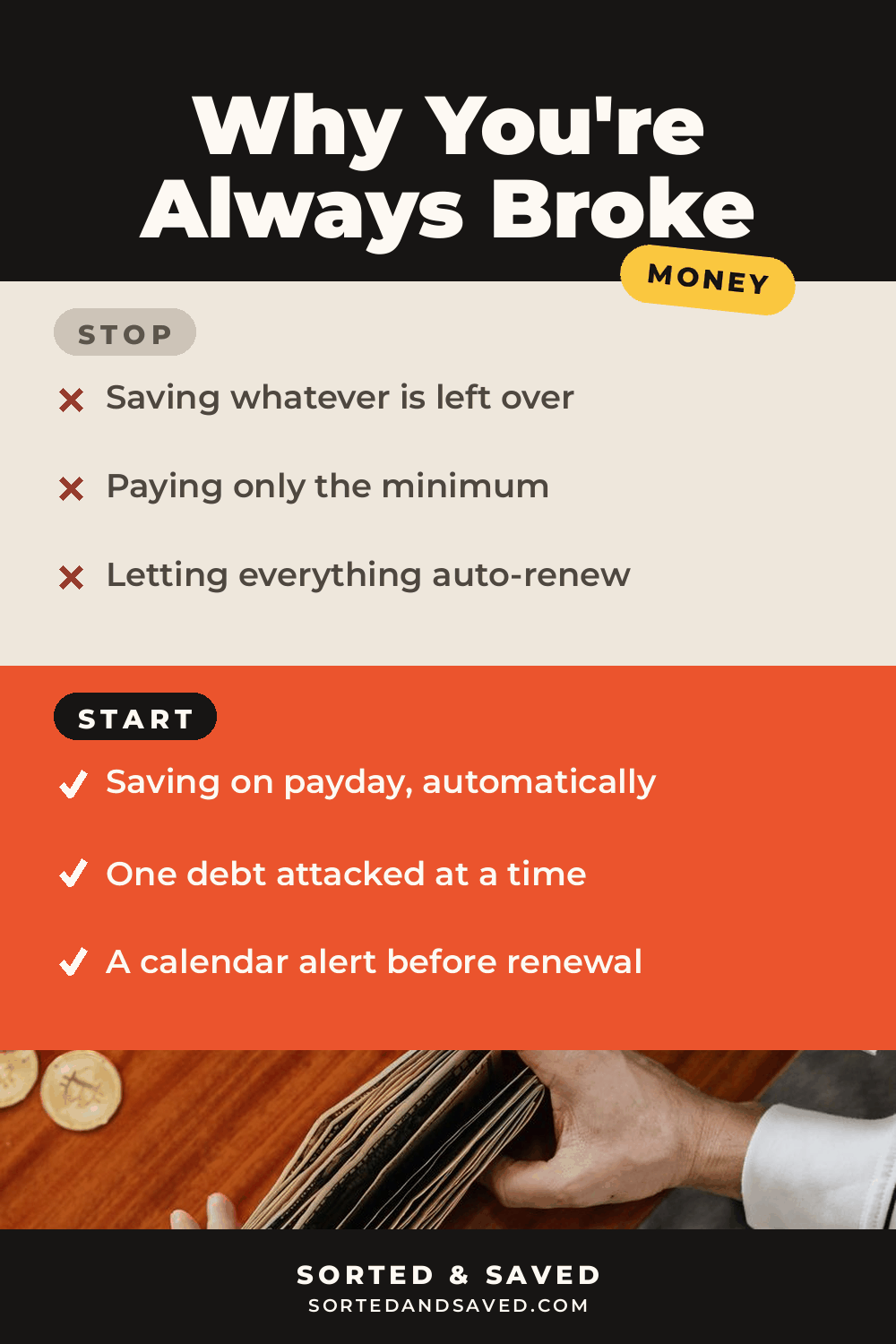
Saving whatever is left at the end
There is never anything left. Spending expands to fill the account, reliably,
regardless of income.Instead: an automatic transfer on payday, before anything
else moves. Start at an amount that feels almost too small — the mechanism
matters far more than the figure, and it can be raised later without noticing. -
No buffer, so every surprise becomes debt
Without a small cushion, a car repair or a boiler goes on a card, and the
interest quietly outlives the problem.Instead: a starter fund of a few
hundred, before anything ambitious. It converts a crisis into an inconvenience,
which is most of what a buffer is for. -
Ignoring the predictable irregular costs
Car insurance, Christmas, school shoes, the annual renewal. These are known
and dateable, and they still get treated as surprises.Instead: total them for a year, divide by twelve, and set
that aside monthly — sinking funds, which is the single
most common gap in otherwise sound budgets. -
Paying the minimum
Minimum payments are calculated to keep a balance alive for years. On a
typical card, paying only the minimum can stretch a modest balance across a
decade and cost more in interest than the original purchase.Instead: pick one debt, pay everything spare at it, minimums
on the rest — snowball or avalanche, but one at a time. -
Letting everything auto-renew
Insurance, broadband, subscriptions, memberships. Loyalty is priced as
inattention, and the renewal quote is routinely worse than the new-customer one.Instead: every contract end date in the calendar with a
three-week alert. One afternoon a year and the saving
repeats monthly without further effort. -
Budgeting for a month that never happens
The plan assumes no takeaways, no birthdays, no impulse anything. Week two
arrives, reality intervenes, the budget is “broken”, and it gets abandoned
entirely.Instead: build in a personal allowance and a miscellaneous
line, because both are real. A budget that survives contact with an ordinary
month beats a perfect one that lasts eleven days — see
the four methods for which structure suits you. -
Frugality theatre
Agonising over small everyday purchases while the large recurring numbers —
rent, car, insurance, subscriptions — go unexamined for years. It burns
willpower on the wrong end of the problem.Instead: audit the big recurring costs once a year and stop
policing the small ones. That is where the real money is, by a wide margin. -
Not knowing where it actually goes
Almost everybody underestimates their own spending, and the gap is usually in
groceries, eating out and small online purchases.Instead: one month of real numbers from your statements, not
from memory. It is the prerequisite for every other fix on this list and it takes
about an hour.
 Save
SaveThe order to fix them in
Doing all eight at once is how none of them happen. This order gets a result
fastest:
- One month of real numbers — an hour with your statements.
- Automate one transfer on payday, however small.
- Kill the auto-renewals — one afternoon, permanent saving.
- Build the starter buffer with what the first three freed up.
- Then attack one debt, with everything spare.
Each step funds the next, which is what makes it hold. Trying to save, clear
debt and cut spending simultaneously usually produces none of the three.
What works
- Saving automatically on payday
- A small buffer before anything ambitious
- Sinking funds for known irregular costs
- One debt attacked at a time
- Contract end dates in the calendar
- A budget with slack built into it
What to watch
- Saving whatever is left at month end
- Putting every surprise on a card
- Treating Christmas as unexpected
- Spreading spare money across all debts
- Auto-renewing insurance and broadband
- A budget that assumes a perfect month
Two that are not really about money
Comparison. A large share of unplanned spending follows time
spent looking at other people’s houses, holidays and kitchens. The fix is
mechanical rather than moral — unfollow the accounts that reliably end in a
purchase, as in the impulse spending post.
Avoidance. Not opening the banking app because it will be
bad news is extremely common and it makes everything worse — the overdraft
charge, the missed renewal, the direct debit that failed. Ten minutes weekly,
attached to something you already do, is enough to stop that entirely.
 Save
SaveIf your income is irregular
Every item above still applies, with one adjustment: build on your lowest
realistic month rather than an average, and treat everything above that as a
surplus to allocate deliberately rather than absorb.
The automatic transfer is harder here and matters more, because a good month
followed by no allocation is how variable-income households end up with nothing
saved after a strong year. Budgeting on irregular
income covers the mechanics.
General information, not advice for your circumstances. For problem debt, a
non-profit credit counsellor is the right call rather than another budgeting
method — the
Consumer
Financial Protection Bureau publishes free guidance on debt help and on how
to tell a legitimate counselling service from a fee-harvesting one.
Common questions
and it is the difference between saving something every month and saving nothing
for years, because there is never anything left over — spending reliably expands
to fill whatever is in the account.
insurance on auto-renew, a car payment, and grocery spending nobody has looked at
in two years. One month of real numbers usually makes it obvious within an hour,
and it is rarely what people expect.
cushion the next unexpected cost goes straight back on the card, which is how
people clear a balance twice and never get anywhere.
shop, a list, and fewer trips does more than switching supermarket —
the grocery reset covers it, and it typically frees more
than any of the small economies people try first.
Start with the statements
Open your banking app and read one month, line by line. Not your memory of
it — the actual list.
It takes an hour and it makes the next four fixes obvious. Then set one
automatic transfer for payday, however small, and check it during
your weekly reset.