
Most advice on how to stop impulse spending is really advice on trying
harder, and trying harder is the one approach with a documented failure rate of
close to a hundred percent. Willpower is a finite thing that runs out in the
evening, which is exactly when the shopping app is open.
The approach that works is unglamorous. Make buying slower. Every impulse
purchase depends on a very short path between wanting something and owning it,
and that path is something you can lengthen deliberately.
 Save
SaveWhy it is not a discipline problem
The gap between wanting something and owning it used to be considerable —
a shop, opening hours, a journey, cash in a pocket. It is now four seconds and a
fingerprint, and every part of that has been optimised by people who are very
good at it.
Saved cards, one-tap checkout, personalised advertising, “buy now pay later”
at the checkout, and notifications engineered to arrive when you are most likely
to act. Against that, an intention formed on Sunday is not a serious defence.
Which is why the fix is structural. You are not trying to become a person who
resists the offer; you are trying to be a person who does not see it, or who
cannot act on it in four seconds.
How to stop impulse spending: six friction changes
-
Delete every saved card
From browsers, from apps, from the operating system’s autofill. Having to
find your wallet and type sixteen digits is a small inconvenience that removes a
surprising proportion of unplanned purchases, because it inserts about ninety
seconds of thinking into a process designed to have none. -
Log out of the apps, and take one off the phone
Log out of everything you shop with. Then delete the single app you use most
— you can still buy from the website, on a laptop, with a card you have to fetch.
That is three deliberate steps instead of a thumb. -
Unsubscribe properly, in one sitting
Twenty minutes clearing every retailer from your inbox. Sale emails are
manufactured urgency arriving on a schedule, and the effect of not seeing them is
immediate. Do the same with notifications: no app needs permission to interrupt
you about a discount. -
Keep a wait list instead of a basket
Anything non-essential over your threshold — twenty, thirty, fifty, whatever
suits — gets written on a list with the date, and nothing else happens for
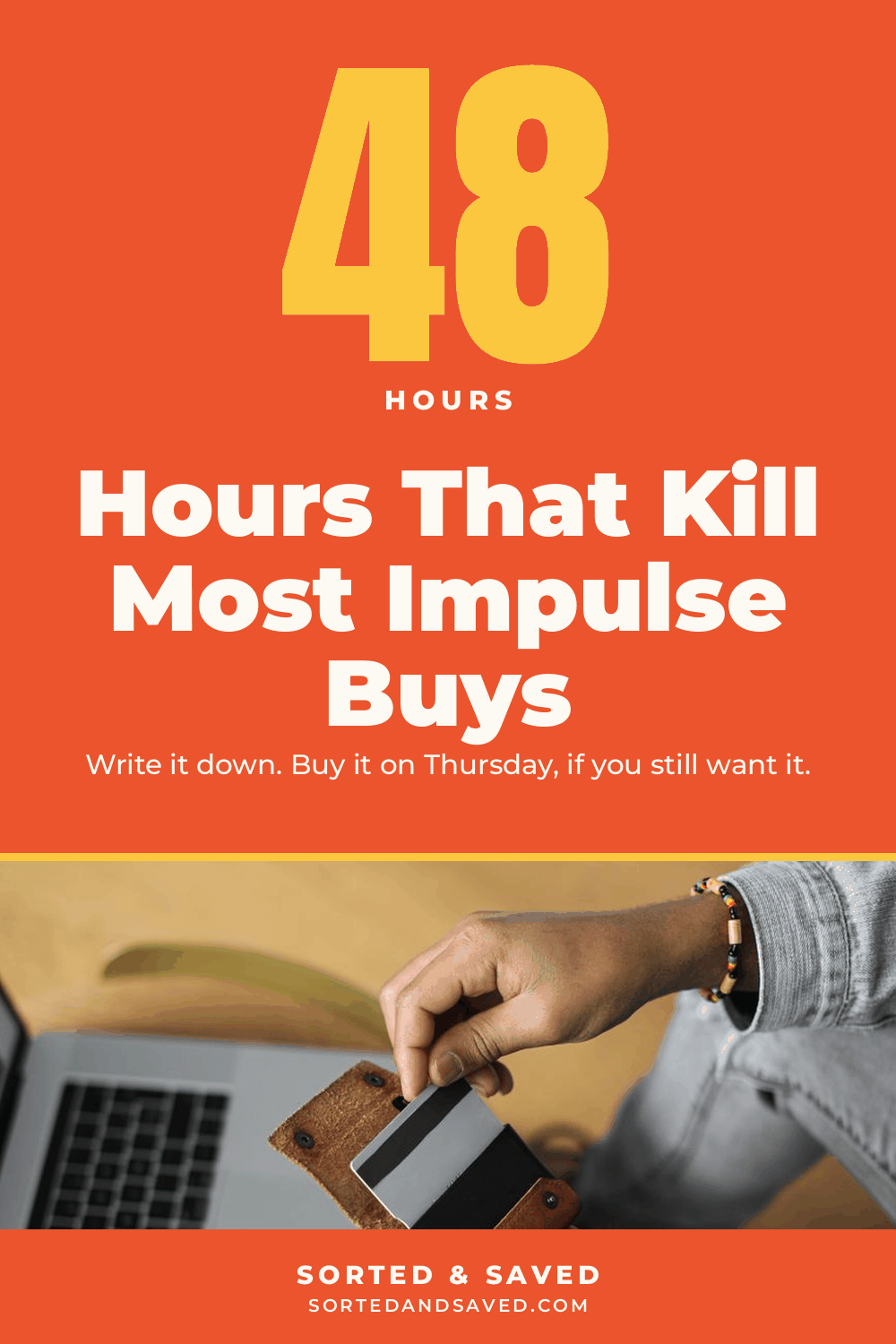
forty-eight hours.Most items never get bought, and the list makes that visible, which is the
part that changes behaviour over time. You can see how much you did not spend.
For larger planned purchases, thirty days works better still. -
Unfollow what sells to you
Accounts whose posts reliably end in a purchase are advertising, whatever
they look like. This includes the ones you enjoy — arguably especially those,
since being enjoyable is what makes them effective. -
Give yourself an allowance
A fixed weekly or monthly amount that is yours, unquestioned, for whatever you
like. Total restriction produces a large rebound purchase in week five, which is
the same reason extreme diets fail.The allowance is what makes the rest of it sustainable, and it belongs in
whichever budgeting method you are already using.
 Save
SaveFind the trigger, not the item
Impulse purchases are rarely about the object. They cluster around states,
and the states repeat.
- Tiredness — late evening buying is the single most common pattern, and the least resistible.
- Boredom — browsing as something to do with a spare ten minutes.
- Stress or a bad day — buying something as a small correction.
- Comparison — after time on social media, or in someone else’s very nice kitchen.
- Celebration — a good week, so a reward.
For two weeks, write down what you bought, when, and what was happening. No
judgement, just the record. Nearly everyone finds one dominant pattern, and it is
usually a time of day.
Knowing it is actionable in a way that a general intention is not. If it is
9pm on the sofa, the answer is that the phone charges in the kitchen — not that
you resolve to be better at 9pm.
What works
- Deleting saved cards and autofill
- A 48-hour wait list with dates
- Unsubscribing from retailer emails
- A small allowance that needs no justification
- Tracking the trigger for two weeks
- Phone out of the room in the evening
What to watch
- Relying on willpower at 10pm
- Keeping items in a basket 'to decide later'
- A total ban with no allowance
- Buy now, pay later at checkout
- Following accounts that reliably sell to you
- Judging yourself instead of the setup
Buy now, pay later
It deserves separate mention because it is specifically engineered to defeat
everything above. Splitting a payment makes the price feel smaller, removes the
moment where the total lands, and turns a purchase you would have questioned into
four amounts that each feel trivial.
The practical rule is to treat it as unavailable. If the full amount is not
affordable today, the item is not affordable — and missed instalments carry fees
and, increasingly, appear on credit files. The CFPB’s
consumer
guidance covers how these products work and where the protections differ from
a credit card.
 Save
SaveWhat to do with what it frees up
Money that stops leaking needs somewhere to go on the same day, or it gets
absorbed and you never see the benefit.
Send it somewhere automatically: an emergency fund
if you do not have one, sinking funds if you do, or
straight at the highest-interest debt. An automatic transfer on payday works
better than a decision at the end of the month, because there is nothing left to
decide.
The same principle applies at the category level — a
grocery reset and a
Black Friday plan are both really just impulse
control with a specific setting attached.
Common questions
next month. The underlying pattern takes longer, usually a couple of months of
noticing the trigger. That is why the setup changes come first: they buy you the
time to work on the rest.
you clearly where the money was going. As a permanent state, no. It is a sprint,
and the rules matter more than the willpower does.
get mentioned first — fifty, a hundred, whatever fits — applying equally to both
of you. Policing someone else’s spending reliably damages the relationship
without fixing the spending.
in exactly this way and never used, is an unusually direct feedback loop. Most
people find a declutter challenge changes their buying
more than any budgeting rule did.
Ten minutes, tonight
Delete the saved cards from your browser and your phone, and log out of the
two apps you buy from most. That is it for today.
Add the wait list this week, and check it during
your weekly reset — the second week, when you see what you
did not buy, is when this starts to feel worth doing.


3 comments