

Nearly every guide on how to declutter your closet opens with the same
instruction: take everything out and put it on the bed. It’s terrible advice for
most people, and it’s why so many closet declutters end at 11pm with everything
shoved back on the rail.
Emptying the closet turns a job you can stop into a job you can’t. Two hours
in, you’re tired, the decisions get worse, and the bed still needs to be usable
by bedtime. So the last third goes back unexamined.
 Save
SaveWhy the empty-everything method fails
Three reasons, and all of them are about stamina rather than willpower.
It has no exit. Once the closet is on the bed you’re
committed to finishing tonight, whatever state you’re in by hour three.
The hardest items come last. By the time you reach the
sentimental and the expensive-but-unworn, you’ve spent all your decision-making
on t-shirts.
The mess is the outcome you were trying to avoid. Making a
room dramatically worse in order to make a closet slightly better is a hard sell
on a Saturday, which is why it gets postponed for months.
How to declutter your closet in three sessions
-
Session one: the obvious no
Forty-five minutes, no categories. Go along the rail and through the drawers
pulling only things that are an immediate, effortless no — damaged, stained,
never worn, wrong size for years, duplicated four times over.Don’t deliberate. If it takes more than two seconds, leave it. This session
usually removes fifteen to twenty percent of the volume and takes almost nothing
out of you, which is the point — it builds momentum before the hard part. -
Session two: category by category
Another day. Work one category at a time — tops, then pants, then dresses,
then knitwear — and take only that category out of the closet.This is where the four questions do the work. One category per sitting is
enough; there’s no requirement to do them all on the same day. -
Session three: shoes, bags, and the hard stuff
Last, deliberately. Shoes and bags are more expensive per item and more
emotionally loaded, and sentimental clothing is the hardest category there is.By now you’ve made several hundred small decisions and the muscle is built.
Starting here on day one is how people stall permanently — the same reason the
30-day declutter challenge puts sentimental items at
the end.
 Save
SaveThe four questions
For anything you’re unsure about, in this order:
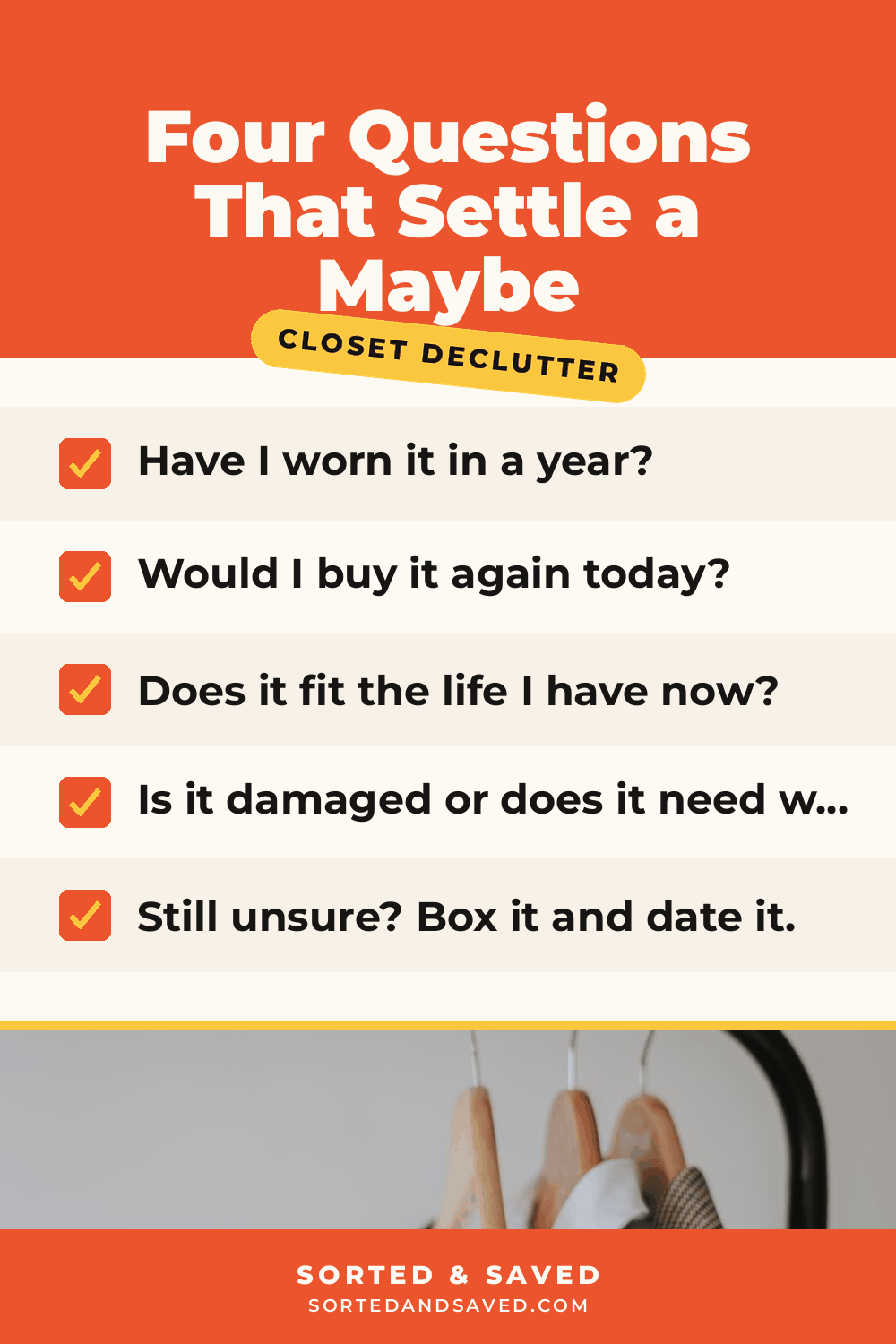
- Have I worn it in the last year? A full year covers every season, so this is the only honest version of the question.
- Would I buy it again today, at full price? This one cuts through what something cost. Money already spent is spent either way.
- Does it fit the life I actually have? Not the job you left, the size you were, or the weekends you don’t have.
- Is it damaged, or does it need altering? If it’s needed a repair for over six months, the repair isn’t happening.
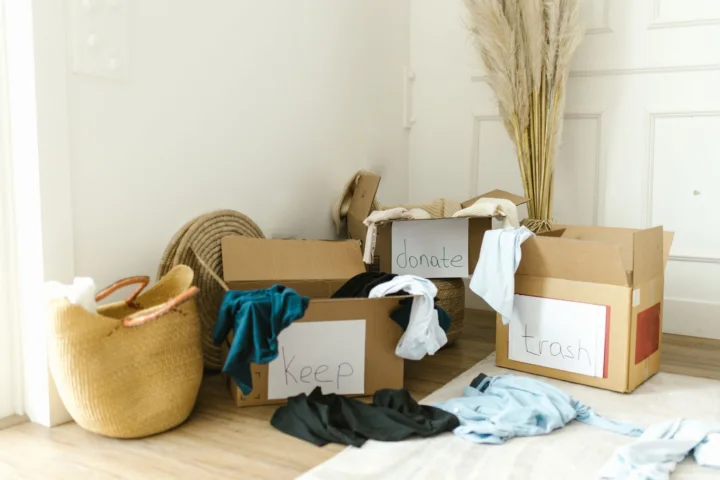
Still unsure after all four? Box it, date the box, and put it out of sight. If
you haven’t opened it in six months, it goes without being reopened. That single
mechanism removes most of the anxiety, because nothing is ever thrown out under
pressure.
Where it should actually go
Donate the wearable, and do it within the week — a donate bag sitting in the
hall for two months is just relocated clutter.
For the genuinely worn out: textiles are one of the least recycled household
materials, and most of what’s put in a donation bin in poor condition is sorted
straight out again. The
EPA’s
data on textile waste is a useful reality check. Many areas have dedicated
textile recycling that takes unwearable fabric — worth five minutes of searching
before bagging it for landfill.
If you plan to sell, set a deadline. Anything unsold in thirty days gets
donated. “To sell” is one of the most common ways a declutter quietly
un-declutters itself.
What works
- Three short sessions
- Starting with the obvious no
- One category per sitting
- The backwards hanger test
- A dated maybe box
- Donations leaving within the week
What to watch
- Emptying everything onto the bed
- Starting with sentimental items
- Buying storage beforehand
- Keeping things for a life you don't have
- An open-ended 'to sell' pile
- Decluttering someone else's clothes
 Save
SaveWhat to do when it’s done
Don’t immediately buy organizers. Live with the emptier closet for two weeks
first — you’ll find that half the storage problem was volume, and the containers
you thought you needed turn out to be the wrong ones.
What keeps a closet decluttered isn’t the annual purge. It’s owning less in
the first place, which also happens to be the single most effective fix for
a laundry routine that can’t keep up.
Run a short version at each seasonal changeover — twenty minutes as part of
the fall reset is enough once the big one is behind you.
Common questions
the rest with a date on it. Keeping four sizes in the closet means getting
dressed involves sorting past clothes that don’t fit every single morning, which
is its own daily cost.
storage cost to the original loss. Sell it if it’s genuinely worth selling, with
a deadline attached. Otherwise let it go.
your maybe box before buying anything — a surprising amount of the time the
thing you’re about to buy is already in it.
this outcome, not a prerequisite for it. Plenty of people end up with a closet
that works perfectly well and looks nothing like a capsule.
Start with forty-five minutes
Session one only. Walk the rail, pull the effortless nos, bag them, and stop.
Nothing goes on the bed.
It’s the shortest session and the one that makes the other two happen.


5 comments