Most people write a grocery list by meal: everything for Monday, then
everything for Tuesday. It is the obvious way to do it and it is why the shop
takes so long — you end up crossing the store four times because Monday needed
milk and Wednesday needed cheese.
A grocery list template sorted by store section fixes that with no extra
effort. Same items, same meals, one lap.
 Save
SaveWhy the grocery list template matters more than the plan
The meal plan decides what you eat. The list decides what you spend, and it
decides how long the trip takes.
Two things happen when the list is disorganized. You walk further, which makes
the shop feel long and encourages the “just get it and go” purchases. And you
miss things, because an item written between two unrelated meals is easy to skip
— which produces a second trip, and second trips are where budgets die.
This is the mechanism behind most of the grocery budget
reset: the saving comes from the list being followed, not from the plan
existing.
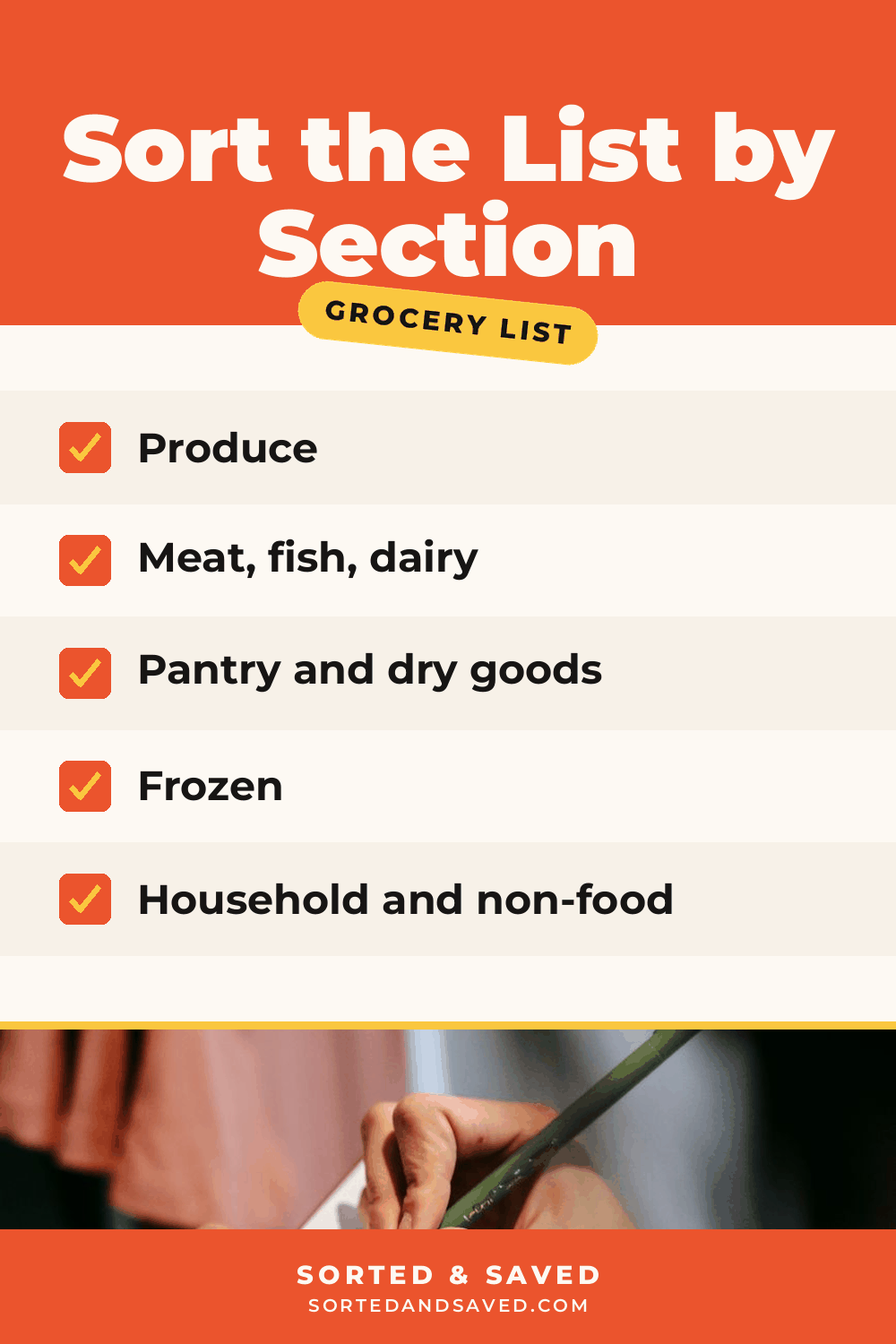
The five sections
- Produce. Fruit and vegetables. Usually the first area of the store, and the one where lists get abandoned first.
- Meat, fish, and dairy. The chilled perimeter. Grouping these also means they spend the least time out of refrigeration.
- Pantry and dry goods. The center aisles — pasta, rice, cans, baking, condiments.
- Frozen. Deliberately last, so nothing starts thawing while you finish. This also pairs with a freezer that has room in it.
- Household and non-food. Cleaning, paper goods, toiletries. These are the items most often forgotten, because they belong to no meal.
Adjust the order to your actual store. The order on the page should match the
order you physically walk, which is the entire point.
 Save
SaveThe master list, built once
-
Write down everything you buy regularly
One sitting, twenty minutes. Work through the five sections and list every
item your household buys more than about once a month.Most households land somewhere between forty and eighty items, and are
surprised by how short it is — the weekly shop feels more varied than it is. -
Print it with a checkbox against each item
Now the weekly job is circling what you need rather than writing a list from
nothing. That is the difference between a ten-minute task and a two-minute
one. -
Leave blank lines in every section
For the meal-specific items that change each week. The master list covers the
staples; the blank lines cover this week’s four dinners. -
Keep it where the shopping is decided
On the fridge, next to the meal plan. A list that lives in a drawer gets
replaced by a scrap of paper, and the scrap is never sorted by section.
Four checks before you leave
Each one prevents a return trip, and a return trip costs more than anything on
the list.
- Check the cabinet, not your memory. Two minutes standing in front of the pantry prevents the third jar of cumin.
- Check the fridge and freezer. Build at least one meal around something already in the house.
- Check the week’s calendar. If two nights are out, you need less food than the plan assumes.
- Check non-food. Trash bags, dish soap, shampoo. These are what send people back out on Wednesday.
What works
- Sorted by store section
- A reusable master list
- Blank lines for weekly extras
- Frozen items listed last
- Checking stock before writing
- The list kept in the kitchen
What to watch
- Sorting the list by meal
- Writing it from scratch weekly
- Keeping it only on your phone
- Shopping without checking stock
- Leaving non-food off the list
- Shopping while hungry
Paper or phone
Both work. Paper is faster to scan and does not put a screen full of
notifications in your hand mid-aisle. A shared phone list wins when two people
shop, because either can add to it during the week.
If you use an app, the same rule applies: set it up with the five sections. An
app-based list sorted by meal has exactly the same problem as a paper one.
For the nutrition side of building a weekly shop,
Nutrition.gov’s
shopping and meal planning resources cover budgeting and balance in more
depth than a list template can.
 Save
SaveWhere the list fits in the week
Right after the meal plan and right before the shop, as a single block. Plan
four dinners, check stock, write the list, go — in that order and in about half
an hour, as part of the Sunday reset.
If you are just starting, the beginner meal plan
covers the step before this one, and the two together are the whole system.
Common questions
place regularly, ordering the sections to match your actual route through it is
worth the five minutes it takes to set up once.
deliberate allowance for one unplanned item. A rule with zero flexibility gets
broken and then abandoned entirely.
week afterwards drops to a couple of minutes of circling. It also stops the
recurring forgotten items, which is the more valuable half.
master list. The main difference is that substitutions need checking — an
unreviewed substitution is how you end up with something nobody eats.
Start by resorting this week’s list
Take the list you were going to write anyway and group it into the five
sections before you leave.
That alone is most of the saving, and it costs nothing but the order you write
things down in.